What Is the Commit Boundary?
Architectural Primitive
This concept is part of the Decision Infrastructure category.
Decision Infrastructure asks
“Should it still happen now?”
Why the Commit Boundary Matters
The commit boundary exists to close the decision-to-execution gap — where approved decisions fail to become outcomes.
It is the point where execution governance is applied, ensuring decisions are revalidated before they become real.
Within a System of Intelligence, the commit boundary is where decisions transition from evaluation to governed execution.
Most systems know how to make decisions.
Very few control what happens when those decisions act.
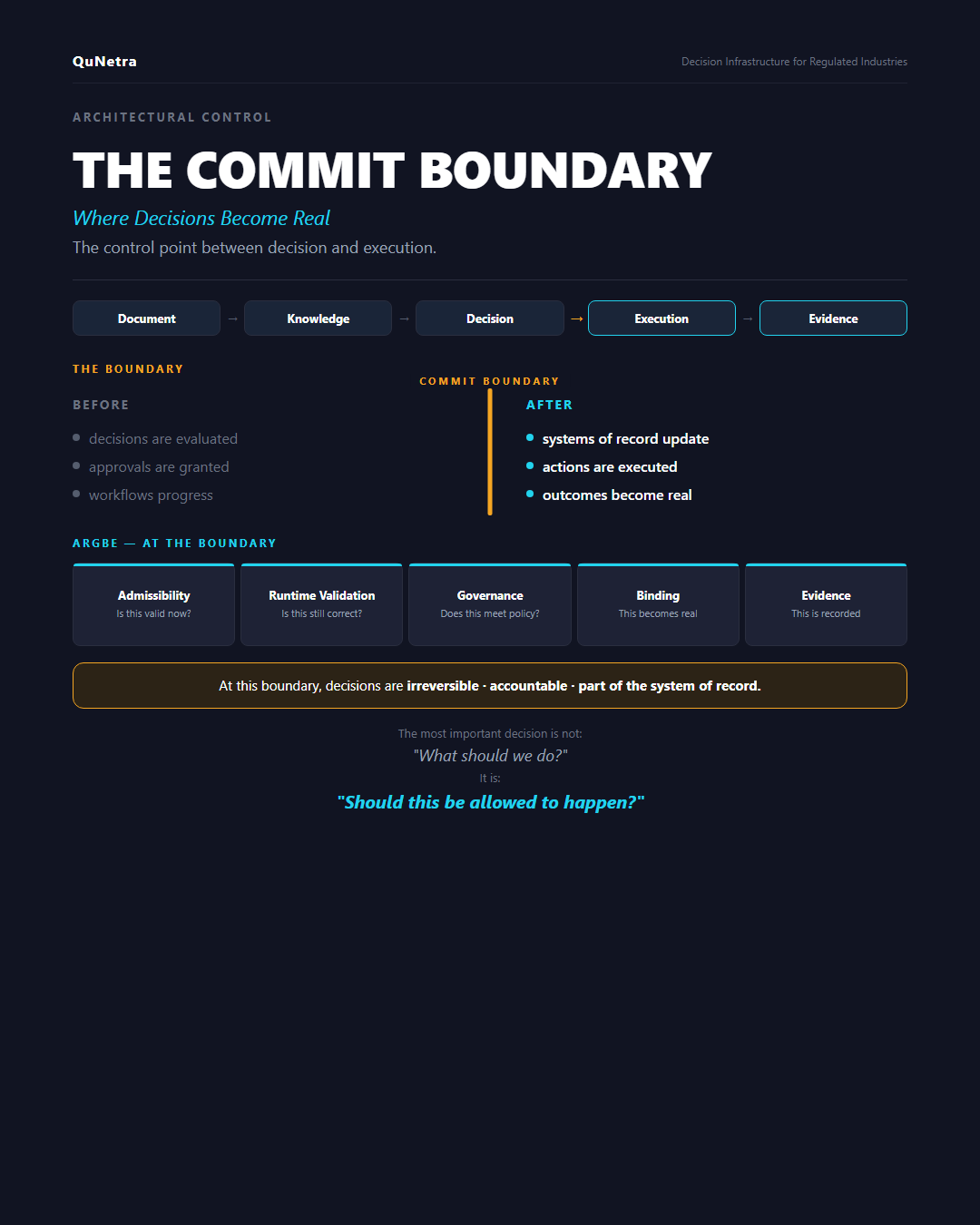
The commit boundary is the point where a decision transitions from evaluation to execution — where it becomes real, irreversible, and accountable.
This is where execution governance is enforced.
This is where:
- Data becomes state
- Intent becomes action
- Risk becomes consequence
And where control must exist.
Every governed outcome passes through this boundary.
How the Category Fits Together
Three distinct roles, one model: the operating model, the category, and the output it produces.
The Execution Spine
The commit boundary sits at the center of the execution spine — the canonical path a single decision travels, from the gap that threatens it to the evidence that proves it. Each layer links to its canonical page.
Where information becomes consequence.
Why Decisions Fail After They Are Made
Across industries, the same pattern repeats. A decision is:
- Valid
- Approved
- Correct
And yet:
It never becomes real.
Loans are approved but not funded.
Actions are authorized but not executed.
Systems agree — but outcomes never occur.
This is not a decisioning problem.
It is an execution governance problem.
The Missing Layer: Control at the Moment of Execution
Most systems:
- Evaluate decisions upstream
- Execute actions downstream
But they lack control at the boundary itself.
The commit boundary introduces a control point where the system evaluates:
- Is this decision admissible right now?
- Does it meet current policy and constraints?
- Has anything changed since it was validated?
- Is there authority for this action?
Only then is execution allowed.
What Happens at the Commit Boundary
This is the point where a system determines whether a decision should be allowed to execute at all.
At the boundary, five things must occur simultaneously:
Admissibility
The decision is valid under current state and policy.
Runtime Validation
It is re-evaluated at the moment of action.
Governance
Enforcement is non-bypassable.
Binding
The decision becomes real.
Evidence
The system records what happened and why.
This is where accountability is created.
Why This Matters for AI Systems
AI systems introduce uncertainty:
- Models drift
- Context changes
- Policies evolve
A decision that was correct earlier may no longer be valid at execution time.
Without a commit boundary
- Systems execute outdated decisions
- Risk accumulates silently
- Failures appear “unexpected”
With a commit boundary
- Execution is continuously governed
- Decisions are validated in real time
- Outcomes are defensible
The Role of Decision Infrastructure
The commit boundary is not a feature.
It is part of a broader architectural layer: Decision Infrastructure.
A system of intelligence that governs how decisions are:
- Validated
- Executed
- Evidenced
at the moment they act.
From Decision to Outcome
Most systems optimize for:
Better decisions.
But enterprises operate on:
Real outcomes.
The commit boundary ensures that a good decision actually becomes real — correctly, safely, and completely.
Without the commit boundary, decisions remain theoretical.
With it, they become governed execution.
Frequently Asked Questions
What is a Commit Boundary?
The commit boundary is the point where a decision transitions from evaluation to execution and becomes real, irreversible, and accountable. It is the control point where intent becomes consequence — where data becomes state, intent becomes action, and risk becomes consequence. Rather than letting an approved decision execute automatically, the commit boundary is where the system revalidates the action against current conditions and resolves it to a verdict before it binds.
Why does the Commit Boundary matter?
Because most consequential failures happen not when a decision is made but at the moment it executes. A loan is approved but funds against changed conditions; an action is authorized but executes after authority lapsed. Without a control point at the boundary, systems execute outdated decisions and risk accumulates silently. The commit boundary matters because it is the only place an enterprise can stop a no-longer-admissible action before it becomes an irreversible outcome.
Where does the Commit Boundary exist in enterprise systems?
It exists at the moment an action is about to mutate state in a system of record — funding a loan, releasing a payment, changing an account, filing a report. In most stacks that moment is unguarded: decision systems exit before execution, workflow tools route to the action and fire it, and observability only describes it afterward. The commit boundary is the architectural position inserted at that moment — above the systems of record and below the act.
What happens at a Commit Boundary?
Five things resolve simultaneously, in real time, before the action binds: Admissibility (is it permitted under current state and policy), Runtime Validation (re-evaluated at the moment of action), Governance (enforcement is non-bypassable), Binding (the decision becomes real), and Evidence (the system records what happened and why). The action resolves to one of four verdicts — ALLOW, HOLD, DENY, or ESCALATE — and only an admissible action proceeds.
What makes a Commit Boundary different from an approval?
An approval records that, at some earlier moment, a decision met policy under the state known then. The commit boundary governs whether that approval is still valid now, at the instant it acts. Approval is a past signal; the commit boundary is a present test. A decision can be fully approved and still be held or denied at the boundary because conditions, authority, or policy have changed in the interval.
What happens if admissibility changes?
If conditions, authority, policy, or risk shift between approval and the act so the decision is no longer admissible, the boundary does not let it commit. Depending on the change, the action is held for revalidation, denied, or escalated to higher authority — with the reason and current state captured as evidence. The boundary continuously re-evaluates actions in flight, so a change after approval invalidates the action before it can execute on stale assumptions.
Can execution be stopped?
Yes. Stopping a no-longer-admissible action before it binds is the boundary's core function. When runtime validation fails, the action resolves to DENY — blocked, with the reason and current state recorded — rather than committing. Because enforcement at the boundary is designed to be non-bypassable, an action cannot route around the control to execute anyway.
Can execution be delayed?
Yes — that is the HOLD verdict. When an action needs revalidation before it can be permitted (a condition pending, evidence to refresh, authority to confirm), the boundary pauses it rather than failing it. The action is held until the condition resolves, then re-evaluated; if it becomes admissible it proceeds, otherwise it is denied or escalated. A hold is a paused action, not a rejected one.
How does the Commit Boundary generate evidence?
Evidence is captured in-line at the moment the action resolves, not reconstructed afterward. For each commit attempt the boundary records the inputs, the checks performed, the policy and authority applied, the verdict, the actor, and the timing — together, as an immutable record. Because it is created as the action occurs, it is fact rather than after-the-fact interpretation, and reconstructable for audit.
Why is the Commit Boundary foundational to Decision Infrastructure?
Because Decision Infrastructure governs how decisions become outcomes, and the commit boundary is the exact point where that governance must happen — where intent becomes consequence. It is the architectural location at which admissibility, validation, governance, binding, and evidence resolve. Without it, decisions remain theoretical and governance is narrative; with it, decisions become governed execution. Every governed outcome passes through this boundary.
Relationship Reading Tree
Relationship to Other Concepts
Decision Infrastructure is part of a connected ontology. Use this relationship tree to understand where this concept fits.
- System of Intelligence
- Decision Infrastructure
- Decision-to-Execution Gap
- Commit BoundaryYou are here
- Execution Governance
- Runtime Admissibility
- Governed Execution
- Evidence at Execution
- Operational Legitimacy (Result)
- Consequence Intelligence (Output)
Reference Surfaces
Reference Surfaces
Reference Surfaces
Understanding a category requires more than comparisons. These reference surfaces explain the core concepts, architecture, vocabulary, and placement of Decision Infrastructure within the enterprise stack.
Definition
What Is Decision Infrastructure?
The canonical introduction to the category. Defines Decision Infrastructure, execution governance, runtime admissibility, and governed execution.
- Category definition
- Execution governance
- Runtime admissibility
- Governed execution
Placement
Where Decision Infrastructure Fits
Where Decision Infrastructure sits between Decision Systems and Consequence Intelligence in the enterprise stack.
- L4 Decisioning
- L5 Decision Systems
- L6 Decision Infrastructure
- L7 Consequence Intelligence
Architecture
Decision Infrastructure Architecture
The architecture that enables execution governance — how Decision Infrastructure operates across enterprise systems.
- Commit boundaries
- Runtime validation
- Execution control
- Evidence generation
Vocabulary
Decision Infrastructure Glossary
The canonical vocabulary of the category — the lexicon analysts can quote precisely.
- Runtime admissibility
- Commit boundary
- Execution governance
- Governed execution
- Evidence at action
Related Concepts
Architectural primitives adjacent to the commit boundary
The architectural primitives that compose Decision Infrastructure — each governs one facet of how execution remains admissible.
Runtime Admissibility
The property that an approved decision remains permitted at the moment it acts.
Execution Governance
The discipline of controlling execution at the moment decisions become consequences.
Governed Execution
Execution that occurs only when policy, authority, conditions, and evidence remain valid at the act.
Evidence at Execution
Evidence captured at the moment of action — not reconstructed afterward.
Decision-to-Execution Gap
The interval between approval and execution where conditions change and admissibility can silently expire.
Control Stack
The 7-layer enterprise architecture in which the commit boundary is the runtime gate at L6 (Decision Infrastructure).
Decision Runtime Trace
The immutable record produced at the commit boundary — the architectural artifact of what the boundary evaluated and how it decided.
Related Comparisons
Related Comparisons
Use these comparisons to understand how Decision Infrastructure differs from adjacent categories, systems, and governance models.
Decision Infrastructure vs Decision Intelligence
The category vs its output cousin — what produces decisions vs what governs them at execution.
Decision Infrastructure vs Decision Governance
Governance defines policy. Infrastructure operationalizes it at execution.
Decision Infrastructure vs Decision Systems
Workflow-and-approvals systems exit before execution; Decision Infrastructure governs the act itself.
Decision Infrastructure vs AI Governance
AI Governance defines what should be allowed. Decision Infrastructure governs whether those permissions remain valid at execution.
AI Governance vs Decision Systems
Why model and process governance frameworks don't close the gap between approval and consequence.
Decision Infrastructure vs Digital Twin
Simulating reality vs governing what is allowed to happen in reality.
Sovereign Reasoning vs Decision Systems
Reasoning under jurisdictional and policy constraints vs the workflow systems that operationalize decisions.
Decision Infrastructure vs Agentic AI
Agents act autonomously; Decision Infrastructure governs whether each autonomous action is admissible at execution.
Decision Infrastructure vs MLOps
MLOps keeps the model healthy; Decision Infrastructure governs whether the decision it informs is admissible at execution.
Decision Infrastructure vs GRC
GRC documents and reviews controls; Decision Infrastructure enforces them on each action at execution.
Decision Infrastructure vs iPaaS
iPaaS connects systems and moves data; Decision Infrastructure governs whether the action between them should execute.
Decision Infrastructure vs Observability
Observability explains execution; Decision Infrastructure governs whether it should occur at all.
Decision Infrastructure vs Knowledge Graphs
Knowledge graphs map what is connected; Decision Infrastructure governs whether an action across those connections is admissible.
Decision Infrastructure vs Sovereign Reasoning
Sovereign Reasoning bounds how AI reasons; Decision Infrastructure governs whether the resulting action is admissible at execution.
Decision Infrastructure and Palantir
Palantir integrates data and drives action; Decision Infrastructure governs whether each action is admissible at execution — across any platform.
Decision Infrastructure and ServiceNow
ServiceNow runs and automates the workflow; Decision Infrastructure governs whether each action it fires is admissible at execution.
Decision Infrastructure and Pega
Pega manages decision workflows; Decision Infrastructure governs whether execution remains legitimate at the act.
Decision Infrastructure and Appian
Appian automates process execution; Decision Infrastructure governs consequence authorization at the commit boundary.
Decision Infrastructure and FICO
FICO optimizes decision quality; Decision Infrastructure governs whether a scored decision is still admissible at execution.
Decision Infrastructure vs Middleware
Middleware passes messages between systems; Decision Infrastructure governs whether the action a message triggers should execute.
Decision Infrastructure vs BPM
BPM orchestrates the process and moves work to the action; Decision Infrastructure governs whether that action should commit.
Decision Infrastructure vs Workflow Automation
Workflow automation runs the sequence; Decision Infrastructure governs whether each action in it should commit.
Decision Infrastructure and Salesforce
Salesforce runs the customer workflow; Decision Infrastructure governs whether each action it fires remains legitimate at the act.
Decision Infrastructure and Celonis
Celonis reveals how processes run and drives action; Decision Infrastructure governs whether that action is admissible at execution.
Decision Infrastructure and Icertis
Icertis manages contracts and obligations; Decision Infrastructure governs whether an action taken under them is admissible at execution.
Decision Infrastructure and Encompass
Encompass runs the loan workflow; Decision Infrastructure governs whether each consequential loan action is admissible at execution.
Decision Infrastructure and Empower
Empower runs loan origination; Decision Infrastructure governs whether each consequential loan action is admissible at execution.
Decision Infrastructure and Harvey
Harvey generates legal reasoning and drafts; Decision Infrastructure governs whether the actions taken from that reasoning are admissible at execution.
Decision Infrastructure and iManage
iManage manages legal knowledge; Decision Infrastructure governs the consequential actions taken using that information at execution.
Decision Infrastructure and Intapp
Intapp coordinates legal intake, conflicts, and approvals; Decision Infrastructure governs whether execution remains admissible at the act.
Decision Infrastructure and Relativity
Relativity surfaces and reviews evidence; Decision Infrastructure governs the consequential actions taken because of it at execution.
Decision Infrastructure and Reveal
Reveal surfaces evidence with AI-assisted review; Decision Infrastructure governs the consequential execution based on it.
Decision Infrastructure and Aderant
Aderant runs the business of law; Decision Infrastructure governs whether the consequential actions those operations drive are admissible at execution.
Decision Infrastructure and NetDocuments
NetDocuments manages legal documents and knowledge; Decision Infrastructure governs the consequential actions taken using that information.
Decision Infrastructure and Contract Lifecycle Management
Contract lifecycle platforms manage the contract; Decision Infrastructure governs whether actions taken under it remain admissible at execution.
Decision Infrastructure and Litera
Litera drafts, compares, and perfects legal documents; Decision Infrastructure governs whether the actions taken from those documents are admissible at execution.
Related Reading
Long-form explorations of the commit boundary
Platform & Vision